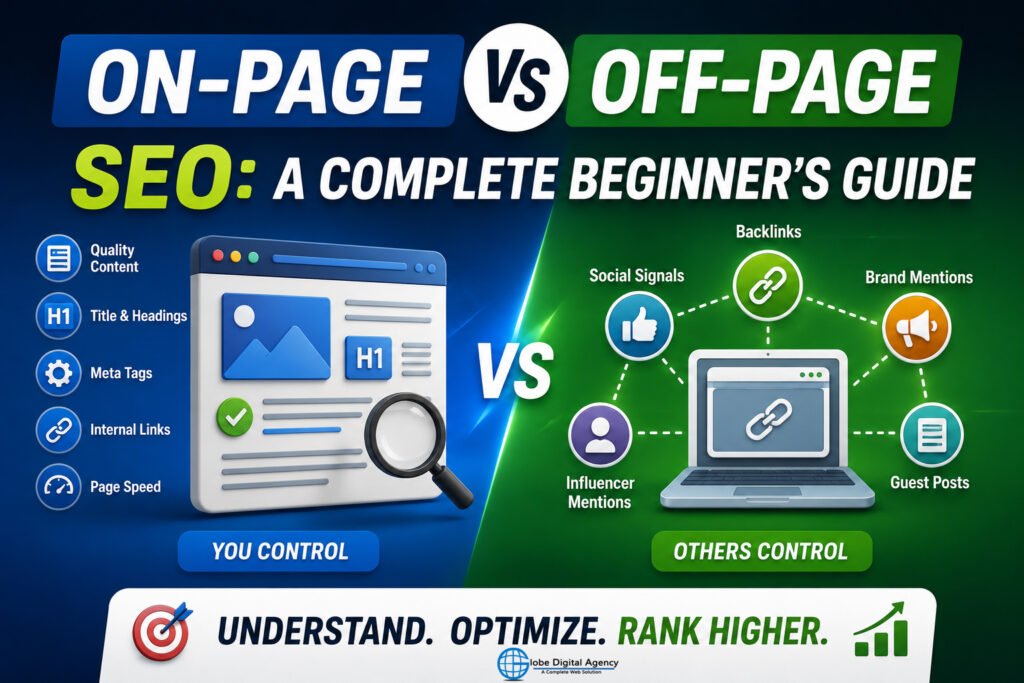

If you have started learning about SEO, you have probably run into two terms over and over again. On-page SEO and off-page SEO. They sound like opposites. But in reality, they are two halves of the same strategy. And you need both to rank well on Google.
This guide breaks down exactly what each one means.
How they differ. And how to prioritise them when you are just getting started.
What Is On-Page SEO?
On-page SEO refers to everything you can directly control on your own website. It is about helping search engines understand and rank your content. Think of it as tidying your own house before inviting guests over. It is entirely within your control.
Key on-page SEO elements include:
Title tags and meta descriptions
These tell both Google and users what a page is about. A well-written title tag with your target keyword near the front can meaningfully improve click-through rates.
Header tags (H1, H2, H3).
Proper heading structure helps search engines understand the hierarchy of your content. It also makes pages easier for readers to scan.
Keyword placement.
Naturally incorporate your target keyword and related terms into your title, headers, URL, and body content. Do not stuff keywords. Just signal relevance.
Content quality and depth.
Google increasingly rewards comprehensive, genuinely useful content. Short, thin pages do not cut it anymore. Answer the searcher’s question thoroughly.
Internal linking.
Link between related pages on your own site. This helps distribute authority. It also helps users and search engines discover more of your content.
Image optimization.
Compress file sizes. Add descriptive alt text. Use proper file names. This improves both load speed and accessibility.
Page speed and Core Web Vitals.
Slow-loading pages hurt both rankings and user experience. Tools like Google PageSpeed Insights or GTmetrix can highlight specific issues.
Mobile-friendliness.
With mobile-first indexing, your site needs to perform just as well on a phone as it does on a desktop.
URL structure.
Clean, descriptive URLs are easier for both users and crawlers to understand.
For example, /on-page-vs-off-page-seo is far better than /page?id=4821.
Because all of these factors live on your own site, on-page SEO is usually the best place for beginners to start. It is measurable. It is controllable. And you will see the impact of changes relatively quickly.
What Is Off-Page SEO?
Off-page SEO covers everything that happens outside your website. It influences how search engines perceive your authority and trustworthiness. If on-page SEO is tidying your house, off-page SEO is your reputation in the neighbourhood. What do other people say about you? How many people vouch for you?
Key off-page SEO elements include:
Backlinks.
Links from other reputable websites pointing to yours remain one of the strongest ranking signals.
Quality matters far more than quantity.
A single link from a respected industry publication can outweigh dozens of low-quality directory links.
Domain authority and trust signals.
These are built over time through consistent, link-worthy content and a clean backlink profile.
Brand mentions.
Even unlinked mentions of your brand across the web can contribute to how search engines assess your credibility.
Social signals.
While social shares are not a direct ranking factor, content that gets shared widely tends to earn more organic backlinks and visibility.
Guest posting and digital PR.
Contributing content to other reputable sites builds both backlinks and brand authority.
Being featured in press coverage does the same.
Local citations and reviews.
For businesses with a physical presence, consistent listings on directories matter.
Think Google Business Profile, Yelp, and industry directories. Positive reviews strengthen local SEO performance.
Influencer and partner collaborations.
Partnering with relevant voices in your industry can drive both referral traffic and earned backlinks. Off-page SEO takes longer to build. It is harder to control directly. You cannot force another website to link to you.
But it is often what separates a page that ranks on page one from a similar page that does not.
On-Page vs Off-Page: Key Differences at a Glance
| Factor | On-Page SEO | Off-Page SEO |
| Location | Within your website | Outside your website |
| Control | Full control | Limited/indirect control |
| Speed of impact | Faster to implement and measure | Slower, builds over time |
| Main goal | Relevance and usability | Authority and trust |
| Examples | Title tags, content, site speed | Backlinks, brand mentions, PR |
Which Should You Focus On First?
If you are just starting out, begin with on-page SEO. It is free. It is fully within your control. And it lays the foundation that off-page efforts will later build on.
There are little point earning backlinks to a page that is poorly optimised or slow to load. Once your on-page fundamentals are solid, shift attention toward off-page strategies. Earn quality backlinks. Build brand mentions. Secure reviews or citations if you serve local customers.
Final Thoughts
On-page and off-page SEO are not competing strategies. They are complementary halves of a single approach. Strong on-page SEO makes your site easy for search engines to understand and rank. Strong off-page SEO builds the authority and trust that pushes you above competitors with similar content. Neglect either one, and you will struggle to compete in search results. No matter how good your product or content is. Start by auditing your own pages for the on-page basics covered above. Then gradually build an off-page strategy focused on quality over quantity. SEO is a long game. But it is one of the most durable, cost-effective ways to grow visibility online.
Need Help with Your SEO Strategy?
If you are feeling overwhelmed or unsure where to start, we can help. At www.globedigitalagency.com, we work with businesses to build practical, results-driven SEO strategies.
Whether you need technical guidance, content support, or a full audit of your current setup, our team is here to help you get it right.